Architecture
SPM-Kit keeps numerical behavior in a presentation-independent core. The CLI, Fathom, notebooks, and third-party applications orchestrate the same public models and analysis functions; they do not carry alternative scientific implementations.
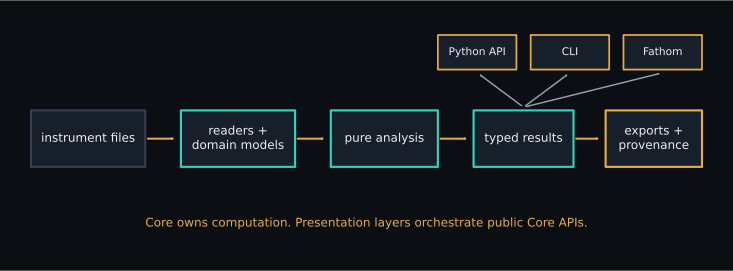
Figure 1. Dependency direction and the main public data path. The diagram is
generated by scripts/gen_theory_diagrams.py.
Dependency boundary
core/does not import fromcli/orgui/.- the CLI and Fathom import public Core interfaces;
- parsers live under
core.io, calculations undercore.analysis, and serialization under the export/report layers; - companion repositories communicate through files, manifests, commands, and public packages rather than private module imports.
Core layers
| Layer | Responsibility | Typical contract |
|---|---|---|
core.io |
detect and read supported variants | path → SPMData or force-data model |
core.models |
carry arrays, units, dimensions, direction, and metadata | immutable typed values |
core.analysis |
leveling, statistics, spectral, force, KPFM, grain, and resonance work | model + explicit parameters → result |
core.export, reports |
serialize inspectable artifacts | result → CSV, JSON, HDF5, image, or report |
cli |
stable shell orchestration | command arguments → files and terminal summary |
gui / Fathom |
interactive orchestration | user selection → Core call → visual result |
Public boundary
from spmkit import load
from spmkit.core.analysis import kpfm, leveling, roughness, spectral

scan = load("scan.nid")
leveled = leveling.plane_fit(scan["Z-Axis"])
stats = roughness.statistics(leveled)
The object model retains measurement units and lateral ranges. An analysis result can only be interpreted within those units, the declared preprocessing, and the calibration state of the input.
Ecosystem boundary
- Fathom invokes Core through public interfaces.
- Data Hunter records candidate datasets and provenance; it does not certify them or feed them automatically into a campaign.
- Phantoms generates truth-bearing fixtures independently of the analyzer.
- Validation treats an installed SPM-Kit command or package as the system under test and can consume frozen Phantom artifacts.
This direction is scientifically important: the analyzer under test must not generate its own expected answer. See the artifact contracts and implementation map.