
SPM-Kit Data Hunter · Evidence discovery
Find candidate evidence without calling it truth
Data Hunter queries supported public repository APIs, inventories files, normalizes metadata, deduplicates records and classifies possible scientific utility.
Role in one sentence
Data Hunter finds and classifies possible evidence. It does not validate SPM-Kit and does not certify datasets.
Problem it solves
Public records vary from well-described raw/processed/code packages to a DOI with no files. Searching by keyword alone cannot tell a parser fixture from a possible cross-check or a calibrated reference. Data Hunter makes that triage explicit and resumable while leaving the final scientific decision to a human.
What it does
- queries Zenodo and Figshare file-capable APIs and DataCite metadata;
- normalizes source records and file inventories into a persistent catalog;
- deduplicates records and applies an AFM/SPM relevance gate;
- classifies file types and evidence utility with token-aware rules;
- runs named campaigns with page/cursor checkpoints and duration/record budgets;
- probes remote files without executing content;
- plans and performs selected downloads with explicit size/safety limits;
- preserves source, query, identifiers, license metadata, checksums and events;
- exports JSON, JSONL, CSV and Markdown views from SQLite.
What it deliberately does not do
- scrape arbitrary websites or bypass repository APIs;
- execute downloaded code or trust archives;
- make a DOI, score or Gold label into ground truth;
- infer redistribution rights from public visibility alone;
- compare SPM-Kit numerical results;
- automatically feed every discovery into Validation.
Installation
The package is not on PyPI. Install the separate repository:
git clone https://github.com/kegouro/spmkit-data-hunter.git
cd spmkit-data-hunter
python -m venv .venv
source .venv/bin/activate
python -m pip install -e ".[dev]"
spmkit-data-hunter doctor
spmkit-data-hunter sources list
doctor reports configured capabilities without printing token values. Live
campaigns use network APIs and should be run only with the intended time,
record and download budgets.
First successful offline command
This exercises deterministic internal behavior without querying public services or downloading data.
Verified campaign command sequence
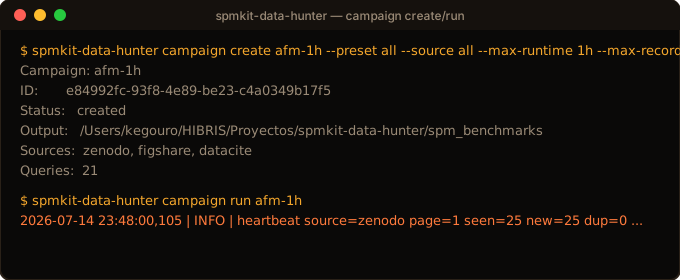
spmkit-data-hunter campaign create afm-1h \
  --preset all \
  --source all \
  --max-runtime 1h \
  --max-records 0 \
  --output spm_benchmarks

spmkit-data-hunter campaign run afm-1h --output spm_benchmarks
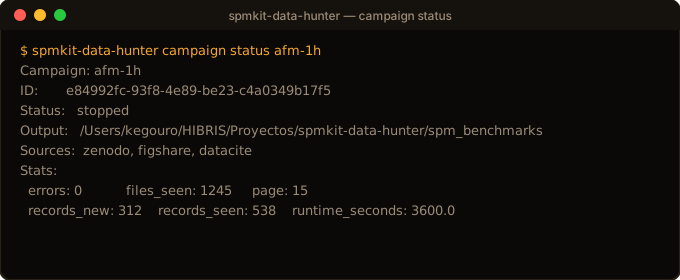
spmkit-data-hunter campaign status afm-1h --output spm_benchmarks
spmkit-data-hunter campaign export afm-1h --output spm_benchmarks
Ctrl+C requests a safe pause at the last committed page checkpoint. Resume
with campaign resume. A completed search says the configured sources/budgets
were traversed; it says nothing about scientific truth.
Detailed workflow
define campaign
    ↓
query public repository APIs
    ↓
normalize records and file inventories
    ↓
deduplicate + AFM/SPM relevance gate
    ↓
classify evidence utility
    ↓
human review of files, methods, license and role
    ↓
download only selected records
    ↓
transfer an accepted case to fixture or validation design
The transfer after human review is manual and documented. A rejected or incomplete candidate remains useful provenance; it should not disappear merely because it failed to become a benchmark.
Outputs
spm_benchmarks/
├── catalog.sqlite3       normalized records and file inventories
├── campaigns.sqlite3     configurations, page checkpoints, events and stats
├── catalog.json          replaceable export view
├── catalog.jsonl         one normalized record per line
├── catalog.csv           compact tabular review view
├── REPORT.md             human-readable campaign/catalog summary
└── datasets/             only files explicitly selected for download
catalog.sqlite3 is the record/file source of truth. campaigns.sqlite3
stores progress and control state. JSON/JSONL/CSV/Markdown are regenerated
views. Stop the process before copying SQLite databases and include -wal and
-shm files when they exist.
Supported public sources
| Source | Current role | File inventory | Checkpoint |
|---|---|---|---|
| Zenodo | direct repository | yes | page |
| Figshare | direct repository | yes | page |
| DataCite | metadata index | usually no | cursor |
DataCite records are metadata evidence and are not represented as fully hydrated dataset packages. OSF, Dataverse, Dryad and other adapters are planned, not current support.
Evidence categories
| Utility class | Plain-language meaning | Possible next use |
|---|---|---|
benchmark_ready |
raw plus distinct processed/reference material and method/code signals | strong candidate for human-designed analysis comparison |
crosscheck_candidate |
raw and processed assets exist but method/code is incomplete | preliminary comparison and follow-up |
reader_fixture |
native raw material without a matched numerical reference | parser, channel and robustness testing |
processed_reference_only |
processed output exists without recoverable raw input | context, examples or literature tracing |
documentation_only |
method/code/docs without a usable data pair | implementation or protocol context |
incomplete |
relevance or evidence chain is insufficient | retain provenance; do not promote |
A score or utility class prioritizes review. It does not establish calibration, method equivalence or scientific truth.
What makes a dataset useful?
| Package contents | What it can support | What remains missing |
|---|---|---|
| raw file only | reader and metadata fixture | expected scientific output |
| raw + processed output | candidate numerical cross-check | matched method, units and parameters may be absent |
| raw + code | reproducible implementation candidate | external independence and calibration still need review |
| raw + methods | interpretable campaign design | executable reference may be absent |
| linked publication | provenance and experimental context | paper values may not map to downloadable arrays |
| calibrated reference | possible physical-validation proposal | traceability, uncertainty and lawful access require audit |
| possible blind holdout | future confirmation design | must remain unexposed and preregistered before use |
More metadata can make a record easier to assess. It cannot make a weak physical reference strong by itself.
Safe download path
spmkit-data-hunter download plan afm-1h \
  --output spm_benchmarks \
  --level gold silver \
  --category raw processed

spmkit-data-hunter download run afm-1h \
  --output spm_benchmarks \
  --level gold silver \
  --category raw processed \
  --max-file-gb 2 \
  --max-record-gb 20 \
  --inspect-archives
Planning downloads writes no files. --accept-unbounded-downloads acknowledges
a transfer risk only; it is not a scientific filter.
Architecture and integration
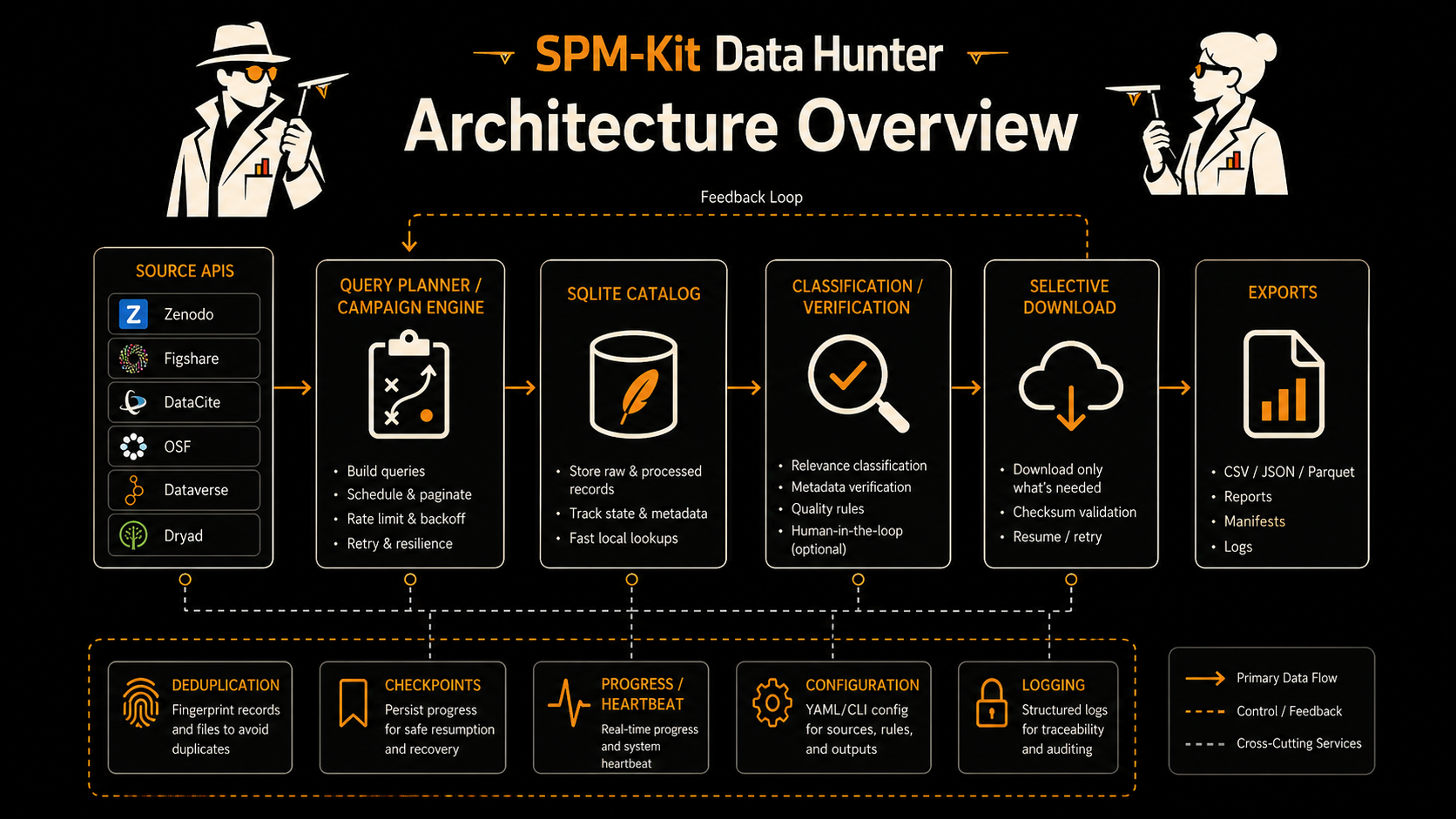
- Data Hunter → human review: implemented output and required decision gate.
- Human review → Core fixture: documented manual handoff; requires lawful redistribution or a private test arrangement.
- Human review → Validation design: documented manual handoff; mensurand, reference, independence and tolerance must be frozen separately.
- Automatic Data Hunter → Validation pipeline: not implemented and not implied.
Scientific status and limitations
Data Hunter's offline classification/campaign machinery is software-tested.
Live source completeness depends on public APIs, query wording, metadata and
campaign bounds. Discovery does not grant LEVEL 2, LEVEL 3 or higher evidence
to a dataset or SPM-Kit capability.
- External input is untrusted; URL, payload, archive and metadata safety matter.
- Repository licenses and record rights can be incomplete or ambiguous.
- A raw native file can validate a parser route only within its demonstrated scope.
- Public records may change or disappear; preserve identifiers and checksums.
- Human scientific review remains mandatory.
Contribute
Useful contributions include official-API adapters, offline fixtures for source schemas, file-category rules that avoid false positives, evidence-taxonomy clarifications and human-reviewed dataset proposals with explicit rights.
Repository · Workflow: find a format fixture · Next: Phantoms