KPFM: contact potential and work function
Kelvin probe force microscopy adds an electrical feedback observable to the topographic experiment. The instrument adjusts a DC bias until a selected electrostatic-force component is nulled, producing a spatial map associated with the tip-sample contact-potential difference (CPD).
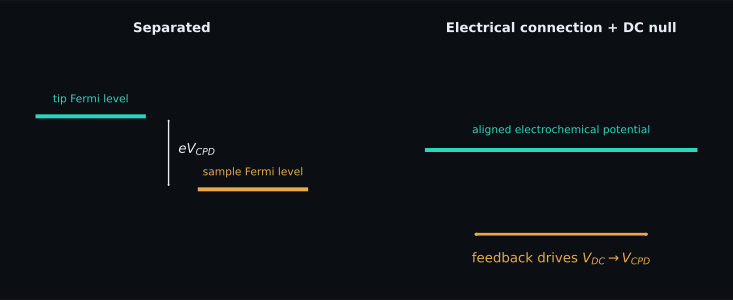
Electrostatic null
With an applied voltage
an idealized capacitive interaction has energy
and force \(F_{\mathrm{el}}=-\partial U/\partial z\). \(C\) is capacitance (F), \(z\) separation (m), voltages are in V, \(\omega\) is angular frequency (rad s\(^{-1}\)), and force is in N. The component at \(\omega\) is proportional to \(V_{\mathrm{AC}}(V_{\mathrm{DC}}-V_{\mathrm{CPD}})\,\partial C/\partial z\). The feedback nulls that term by driving \(V_{\mathrm{DC}}\) toward the instrument's CPD convention.
Work-function relation and sign
A commonly used convention is
when work functions \(\phi\) are expressed in electronvolts and voltage in volts; numerically, one electronvolt per elementary charge corresponds to one volt. If energies are expressed in joules, retain the elementary charge \(e\) (C) explicitly. Some instruments export the opposite CPD sign. Confirm the vendor definition with a reference sample before comparing absolute work functions.
What the map can and cannot mean
Relative CPD contrast can track work-function, doping, charge, surface dipoles, adsorbates, or illumination state. It is also affected by tip contamination, humidity, topographic cross-talk, stray capacitance, lift height, feedback bandwidth, grounding, and whether amplitude- or frequency-modulation KPFM is used. A calibrated tip work function can drift during the same session.
Therefore, a histogram is not chemical identification, and an absolute sample work function requires a calibrated tip, a documented sign convention, environmental context, and a defensible uncertainty budget.
SPM-Kit path and evidence
spmkit.core.analysis.kpfm.statistics reports mean, standard deviation, minimum,
and maximum CPD from an already calibrated voltage channel. With a supplied tip
work function, it applies the algebraic sample-work-function conversion. It does
not demodulate raw detector signals or calibrate the tip.
Use spmkit analyze for a file containing a recognized CPD channel; in Fathom,
inspect the channel under Imagen. These calculations are
LEVEL 1 — SOFTWARE_VERIFIED. No current public physical-reference campaign
supports a general absolute-work-function claim.