Roughness and surface metrology
Roughness parameters summarize deviations from a chosen reference surface. They do not discover that surface automatically, and they do not preserve where features occur. Two physically different surfaces can share the same Sa or Sq.
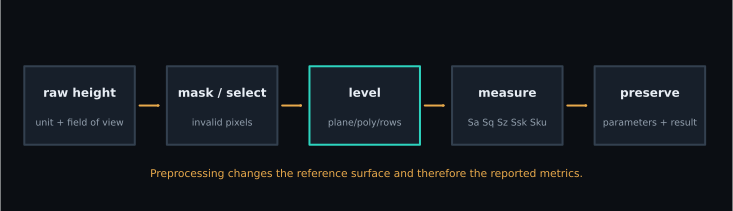
Reference field
Let \(z_i\) be the \(N\) finite sampled heights after declared masking and preprocessing, and let
\(z_i\), \(\bar z\), and \(\eta_i\) share the channel's length unit (usually m or nm). SPM-Kit removes non-finite samples, subtracts the arithmetic mean, and computes the following discrete quantities.
Implemented areal parameters
\(S_a\) and \(S_q\) are heights. \(S_q\) gives greater weight to large deviations; that does not make it more or less correct than \(S_a\).
In the result object, Sv is the signed minimum and Sz = Sp - Sv; all have
height units. A single spike or dropout can dominate \(S_z\).
\(S_{sk}\) and \(S_{ku}\) are dimensionless. This is kurtosis, not excess kurtosis, so a Gaussian distribution tends toward 3. For an exactly flat field, the implementation returns zero for both normalized moments to avoid division by zero; mathematically those ratios are undefined.
Leveling and filtering
spmkit.core.analysis.leveling provides plane, polynomial, and per-row paths.
Plane subtraction can remove sample tilt; it can also remove a real long-scale
slope. Per-row alignment can suppress scanner offsets; it can also erase real
line-to-line structure. Filtering and masks similarly redefine the measured
surface. Report method, order, mask, and processing sequence.
spmkit.core.analysis.roughness.statistics expects the chosen channel already
leveled. The CLI applies plane, poly, or none; Fathom's Imagen
perspective applies user-selected preprocessing before displaying statistics.
Sampling and scale
- Pixel pitch is lateral range divided by sample count under the stored grid convention. Incorrect range metadata corrupts physical spatial scales.
- Field of view controls which long-wavelength form and rare extrema enter the statistics.
- Pixel spacing, tip radius, feedback bandwidth, and filtering limit the smallest observable structure.
- Resampling changes \(N\) and correlation, but does not add instrument bandwidth.
- Compare results only when channel, area, mask, leveling, filtering, and units are compatible.
ISO terminology and implementation scope
SPM-Kit uses ISO 25178 areal names and discrete formulas for the parameters above. It does not claim a complete ISO 25178 filtering, nesting-index, uncertainty, or metrological-traceability implementation. Standards terminology must not be read as certification.
Evidence boundary
The strongest current evidence is restricted to Sa, Sq, and Sz:
- 48 frozen synthetic shared matrices, 144/144 SPM-Kit/Gwyddion 2.71
comparisons within
1e-6 nm + 1e-6 relative; - 12 public experimental GWY records, 36/36 shared-matrix comparisons within the same declared tolerance;
- the real-data parser track separately retained ten equivalences and two channel-count differences.
This supports LEVEL 3 — CROSS_VALIDATED for those metrics and campaign
conditions. It does not transfer to Ssk, Sku, preprocessing equivalence,
universal parser behavior, or physical validation.