Spectral and self-affine analysis
Spatial statistics ask how much a surface varies. Spectral analysis asks at which lateral scales that variation occurs.
Two-dimensional Fourier transform
For a sampled height field \(z(x,y)\), the discrete Fourier transform maps position to spatial frequency:
\(q_x\) and \(q_y\) are spatial frequencies in m\(^{-1}\) when pixel spacing is in metres. A wavelength is \(\lambda=1/q\) under the cycles-per-length convention. The power spectral density is proportional to \(|Z|^2\) with normalization that depends on the discrete convention; comparisons require the same convention.
Radial PSD
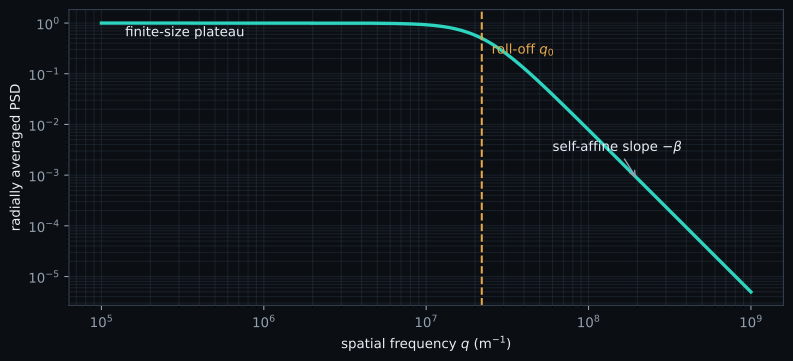
For an approximately isotropic surface, bins of equal \(q=\sqrt{q_x^2+q_y^2}\) are averaged to obtain a one-dimensional radial PSD.
Hurst exponent and fractal dimension
For a two-dimensional self-affine height field, a common convention is
Here \(H\) is dimensionless and, under the model, typically lies between 0 and 1; \(D\) is the corresponding surface fractal dimension between 2 and 3. These relations apply only when a stable power-law band exists. Reporting a slope from a visually selected narrow band is not a universal material property.
Correlation length
The correlation length \(\xi\) (m) is a characteristic lateral scale at which height correlations decay or the PSD changes regime. Its exact estimator and threshold convention matter. It is not automatically the grain diameter or a tip radius.
Sampling and bandwidth limits
- Field width \(L\) limits the smallest resolved spatial frequency to order \(1/L\).
- Pixel spacing \(\Delta x\) limits the highest frequency to the Nyquist value \(1/(2\Delta x)\).
- Leveling suppresses low-frequency content and can move the apparent roll-off.
- Line artifacts create directional spectral power that radial averaging can hide.
- Tip convolution suppresses high-frequency structure; the measured PSD is not the unconvolved surface PSD.
- Windowing trades leakage for spectral resolution and must be reported.
SPM-Kit implementation
spmkit.core.analysis.spectral.radial_psd computes the radial representation;
fractal_dimension fits a declared log-log region and returns PSD slope, Hurst
exponent, fractal dimension and R²; correlation_length estimates the lateral
scale. The CLI path is:
The command applies plane leveling before the spectral calculation. In Fathom,
use Espectral (spectral).
Evidence and limitation
The spectral functions have software and synthetic tests (LEVEL 1/path-specific
numerical recovery). They have not been promoted by the current external
Gwyddion campaigns, which cover Sa, Sq and Sz only. Finite-size, window and tip
effects remain interpretation limits even when a synthetic slope is recovered.