SPM-Kit implementation map
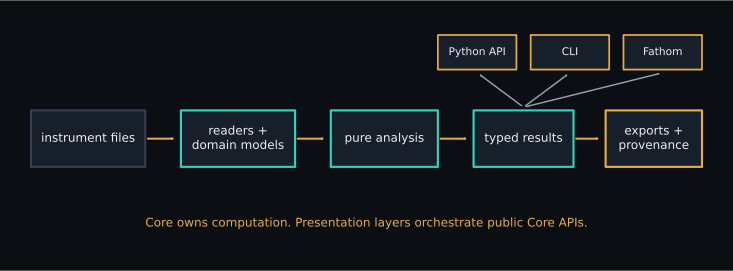
Concept-to-code map
| Concept | Current implementation | Fathom | CLI/public route | Strongest retained evidence | Known limitation |
|---|---|---|---|---|---|
| file inspection/routing | core.io.load_any, core.plugins, built-in readers |
automatic open route | spmkit info |
format-specific Level 1/2 | support is variant-specific |
| leveling | core.analysis.leveling |
Imagen (image) |
roughness --level, analyze --level |
Level 1 + synthetic cases | changes the reference surface |
| arc-revolution background | core.analysis.background |
not exposed | Python API | Level 1 with test-local 1D oracle and synthetic physical tests | finite geometric Z only; no masks, CLI, Fathom or external-equivalence claim |
| sphere-revolution background | core.analysis.background |
not exposed | Python API | Level 1 with independent 2D nearest/reflect oracles and synthetic physical tests | true 2D spherical cap; no masks, CLI, Fathom, external-equivalence or performance claim |
| Sa/Sq/Sz/Ssk/Sku | core.analysis.roughness.statistics |
Imagen (image) |
spmkit roughness, analyze |
scoped Level 3 for Sa/Sq/Sz | external campaigns do not cover Ssk/Sku or every preprocessing route |
| line profile | core.analysis.profiles.line |
Imagen (image) |
Python API | Level 1 | interpolation and coordinate choice matter |
| grain segmentation | core.analysis.grains.detect |
Granos (grains) |
spmkit grains |
Level 1 + synthetic tests | threshold/overlap/tip effects |
| radial PSD/fractal fit | core.analysis.spectral |
Espectral (spectral) |
spmkit psd |
Level 1/path-specific numerical tests | bandwidth and fit-band dependence |
| KPFM statistics/work function | core.analysis.kpfm.statistics |
Imagen (image) |
analyze --tip-wf, Python |
Level 1 | sign convention and tip calibration |
| baseline/contact/elastic fit | core.analysis.forcecurve, mechanics |
Curva de fuerza (force) |
forcecurve, nanomech |
model-specific Level 2 | contact, geometry and material assumptions |
| JKR | core.analysis.experimental |
Curva de fuerza (force) where exposed |
spmkit jkr |
experimental synthetic recovery | adhesive-contact assumptions; CLI marks experimental |
| SMFS WLC/FJC/events | core.analysis.chain |
SMFS (smfs) |
Python API | Level 2 synthetic recovery | polymer model and event-window dependence |
| force-volume maps | core.analysis.forcevolume, forcevolume_fast |
Mapa (map) |
spmkit forcemap |
Level 2 synthetic recovery | invalid curves/calibration propagate spatially |
| batch analysis | core.batch, core.forcebatch |
Batch (batch) |
batch, fbatch |
Level 1 | homogeneous channel/parameter assumptions |
| SHO and thermal spectrum | core.analysis.resonance |
Sintonía térmica (resonance) |
Python API | Level 1 software tests and controlled numerical cases | no frozen calibrated physical-reference campaign |
| frequency-shift mass model | core.analysis.resonance |
Evaporación (evaporation) |
spmkit evaporation |
Level 1 software tests and controlled numerical cases | point-mass/effective-mode assumptions |
| publication figure | core.viz |
Figura (figure) |
spmkit figure |
Level 1 | figure quality is not scientific validation |
| 3D rendering | GUI panel over image domain | Vista 3D (view3d) |
none | GUI/software tested | display transform is not analysis |
| educational simulation | core.analysis.simulation |
Simulador (simulator) |
Python API | software-tested analytical construction | not a calibrated instrument simulator or physical evidence |
Public boundary
core/  ← numerical truth and domain objects
  ↑
  ├── cli/  arguments, files and terminal output
  └── gui/  Fathom routing, parameters, views and reports
Validation invokes the installed public package from another process. Phantoms does not import Core. Those two separations are necessary for useful evidence, but reference independence is still assessed per campaign.
How maturity advances
- Define units, assumptions and failure behavior in Core.
- Add deterministic software tests.
- Recover a known numerical case, preferably from independent Phantoms logic.
- Freeze an external comparison/reference and tolerance in Validation.
- Add calibrated physical and interlaboratory evidence when it exists.
- Expose the stable result in Fathom without changing the equation.